
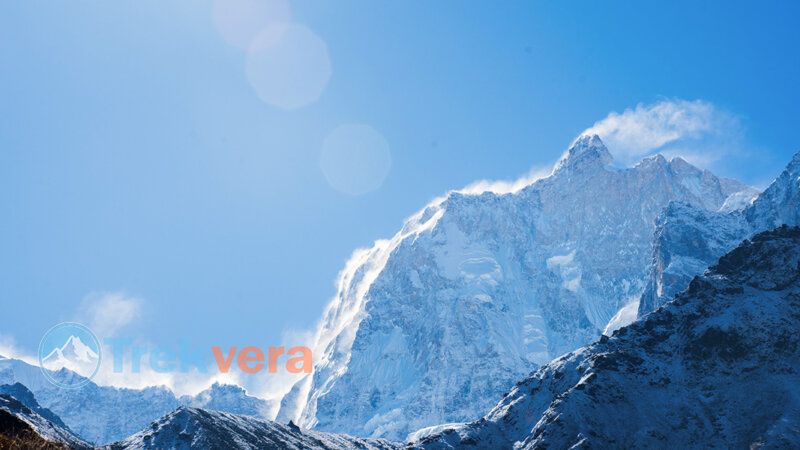
Kanchenjunga Circuit Trek


Trip Overview
Key facts and logistics for planning the Kanchenjunga Circuit Trek
-
Duration 19 Days
-
Trekking Days 17 Days
-
Max Altitude 5,300 m (Pangpema - North Base Camp)
-
Group Size 1 – 15 Trekkers
-
Difficulty Challenging (High-Altitude & Remote Trek)
-
Region Kanchenjunga Conservation Area, Eastern Nepal
-
Best Season March–May & September – November
-
Start/End Point Kathmandu / Kathmandu
-
Accommodation Hotel | Tea House Trekking (Basic to Limited Facilities)


Introduction to the Kanchenjunga Circuit Trek
Kanchenjunga lies in the far-eastern part of Nepal, connecting to the Indian border and situated in the northern region of Taplejung district. Kanchenjunga is also one of the first 8,000-meter peaks to be identified long before Everest was recognized. Like other Himalayan regions of Nepal, this area has also been declared the Kanchenjunga Conservation Area to protect its unique natural environment. If you are lucky in time the iconic red panda, one of the major attractions of this region, adds to its charm. From here, you can admire the world’s third-highest mountain, Kanchenjunga, from both its north and south base camp routes.
Although trekking permission for this region was granted after the 1980s, only a small number of trekkers visit even today. Because of this remoteness, Kanchenjunga has become a favorite destination for travelers seeking extreme adventure and untouched wilderness. Alongside Kanchenjunga stand four other peaks over 8,000 meters, which are often referred to as its subsidiary summits.
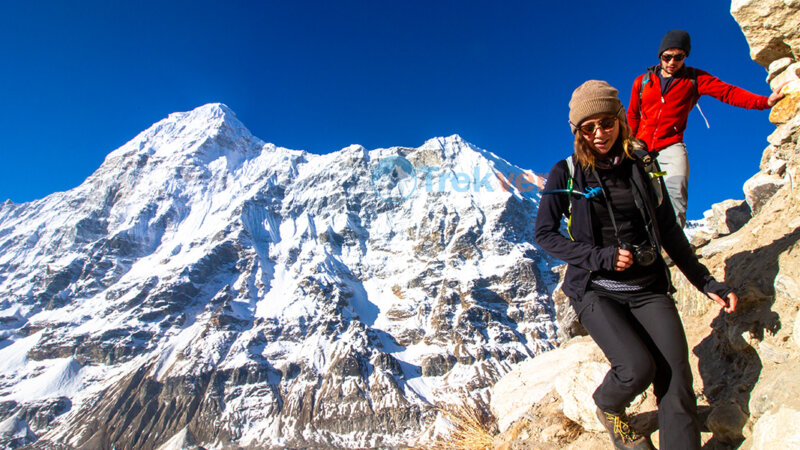
During the trek, you will also witness a stunning range of 7,000-meter peaks, each exceptionally beautiful and captivating. Among them are Khambachen, Jannu (also known as Kumbhakarna), Kabu, Tent Peak, and the Twins.
This region is also one of the starting points of the Great Himalayan Trail, making it a truly remarkable destination to keep on your priority list. Compared to the Annapurna Circuit Trek or Everest Base Camp Trek today as Nepal’s unexplored, crowd-free, and peaceful trekking route, the Kanchenjunga trail promises an entirely new and unforgettable experience for every trekker.
Highlights of Kanchenjunga Circuit Trek
- Standing at the World’s Third Highest Peak: Reach both the North Base Camp (Pangpema, 5,140m) and the South Base Camp (Oktang, 4,730m) for unparalleled, close-up views of Mt. Kanchenjunga.
- The Triple Pass Challenge: Conquer three formidable high-altitude passes in succession, Sinionla (4,646m), Mirginla (4,645m), and Selele La (4,480m) offering 360-degree Himalayan panoramas.
- Glacial Wonders & Hidden Lakes: Walk alongside the massive Yalung Glacier and take a serene side trip to the pristine alpine waters of Nupchu Pokhari.
- Encounters with Rare Wildlife: Trek through a protected sanctuary that is home to the elusive Snow Leopard, the fiery Red Panda, and Blue-Ship.
- Ancient Sherpa & Limbu Culture: Immerse yourself in the high-altitude lifestyle of Ghunsa Village (3,400m), discovering weathered chortens, monasteries, and authentic mountain hospitality.
- Untouched Floral Paradise: Journey through dense forests of vibrant many kinds of rhododendrons, and lilies that paint the lower trails in brilliant colors.
- The Shadow of Jannu Himal: Take an awe-inspiring detour to the base of Jannu (Kumbhakarna), one of the most technically challenging and visually stunning peaks in the world.
- Remote & Raw Wilderness: Experience the true meaning of “off-the-beaten-path” in high-altitude outposts like Lhonak, Tseram, and Khambachen, where the silence is only broken by the wind.
Kanchenjunga Circuit Trek Itinerary
Show All
Day 1: Fly from Kathmandu to Bhadrapur, drive to Taplejung
-
 Accomodation: Hotel
 -
 Meals: Full Board (FB)
 -
 Elevation: ~1,820 m
 -
 Duration: 35min flight + 7-9 hrs drive
 -
 Distance: By Flight: 297KM and By Jeep: 242 km
Your trekking guide will meet you at your hotel. After having breakfast, the guide will escort you to the Kathmandu domestic airport. From there, you will take a scenic 35-minute flight to Bhadrapur in Jhapa, enjoying breathtaking views of various Himalayan ranges along the way.
After landing in Bhadrapur, you will begin an eight-hour jeep drive through Ilam and onward to Taplejung. This journey offers a beautiful glimpse of Nepal’s simple village lifestyle, charming towns, and the country’s pride, the lush tea gardens. You might find it fascinating to see local people picking tea leaves in the fields, and along the way, you may also witness villagers peeling bark to make traditional Nepali paper.

This first day of travel gently introduces you to the true essence of the Kanchenjunga trekking experience and sets the tone for the adventure ahead.
Enjoy a scenic 35-minute flight from Kathmandu to Bhadrapur with stunning Himalayan views, followed by a picturesque jeep drive through Ilam to Taplejung. This journey offers a glimpse of tea gardens, local village life, and sets the perfect tone for your Kanchenjunga trekking adventure.
Day 2: Taplejung to Sekhathum by Jeep & trek to Lamatar
-
Accomodation: Hotel | Teahouse
-
Meals: Full Board (FB)
-
Elevation: ~1,820 m
-
Duration: 5-6 hours
-
Distance: ~ By Jeep 37km and Trekking for 3km
Today marks the first day of your trek. You will begin with a three-hour jeep ride from Taplejung to Sekathum, and from there you will start walking toward Lamatar. On the way to Sekathum, you will see hydropower projects under construction as well as large cardamom farms. This region is inhabited mainly by Limbu and Rai communities, and along the route you will enjoy beautiful views of settlements around the Tamor River and the surrounding agricultural terraces.

The trail to Lamatar follows the Ghunsa Khola upstream. Lamatar is located on the right side of the Ghunsa River, where you will spend the night in a basic teahouse. Since there is no electricity or charging facility available, the power bank you have brought will be very useful here.
Your trek begins with an adventurous drive from Taplejung to Sekathum, followed by a scenic hike along the Ghunsa Khola toward Lamatar, passing cardamom farms and traditional villages of Limbu and Rai communities. This first trekking day offers stunning views of the Tamor River valley and introduces the remote Himalayan teahouse experience.
Day 3: Lamatar to Thyangani
-
Accomodation: Teahouse
-
Meals: Full Board (FB)
-
Elevation: ~2410m
-
Duration: 5-6 hours
-
Distance: ~ 8km
After finishing your breakfast, you will walk for a short while along the Gunsa river with a gentle trail until you reach a suspension bridge, where you will also find a small tea shop. From there, the trail climbs uphill for about one and a half hours. Walking through a forest filled with pine trees, crossing small streams, and enjoying the sight of waterfalls, you will reach Amjilosa. You will stop here for lunch.
After lunch, it takes about two and a half hours to reach Thangye, following a trail that again passes through pine forests. The small wooden bridge and waterfall near Thangye are truly beautiful to see. If you are lucky, you may even spot a red panda on the way. Since the trail goes both uphill and downhill, your legs may feel tired by the time you arrive. That is why today’s stay in a teahouse with dinner and a comfortable dining area will feel relaxing.

From today onward, you will also notice a change in the people’s lifestyle and the way they speak. This area is influenced by Himalayan and Tibetan culture, giving you a glimpse of their unique way of living.
After breakfast, enjoy a gentle walk along the Ghunsa River before ascending through pine forests and waterfalls to Amjilosa, then continue toward Thangye with chances to spot rare wildlife like the Red Panda. This scenic trail offers a mix of uphill and downhill trekking along with a gradual introduction to the unique Himalayan and Tibetan-influenced culture of the Kanchenjunga region.
Day 4: Thange to Phale
-
Accomodation: Teahouse
-
Meals: Full Board (FB)
-
Elevation: ~3215 m
-
Duration: 4–5 hours
-
Distance: ~ 16km
After a peaceful sleep in your riverside teahouse, you will start your day with breakfast and begin today’s trek. The trail once again enters the forest, going both uphill and downhill, and in about three hours you will reach Gyabla. Although many trekkers usually stay overnight in Gyabla, our itinerary is a bit different, so we continue walking toward Phale.

From Gyabla, it takes another three hours to reach Phale. The natural stone gate near Phale looks very beautiful. There are also basic teahouses available for your stay. In Phale, you will get a chance to experience the local lifestyle and also visit the monastery located there. Phale Village was originally established as a Tibetan refugee camp decades ago.
Begin your day with a scenic forest trek from your riverside stop, passing through Gyabla and continuing toward Phale, a culturally rich village in the Kanchenjunga region. Along the way, enjoy unique natural features and experience local life in Phale, where you can visit a monastery and witness strong Tibetan cultural influences.
Day 5: Phale to Gunsa
-
Accomodation: Teahouse
-
Meals: Full Board (FB)
-
Elevation: ~3415 m
-
Duration: 5 – 6 hours
-
Distance: ~ 3-4km
Today is the shortest trekking day of your entire journey. It will also be one of the most enjoyable days because, for the first time, you will get a clear and close view of the Himalayas. You will be able to see Kabu and Ghunsa peaks along the way.

Once you reach Ghunsa, you can enjoy high-speed Wi-Fi, faster than 100 Mbps, and you will also be able to charge all your devices easily. Ghunsa has a police checkpost, a health post,
and the Kanchenjunga Conservation Area office. It is considered the largest village you will encounter during this trek, and it is also known as the main winter settlement of the valley.
Enjoy a short and rewarding trek with your first close Himalayan views, including Kabu Peak and Ghunsa Peak, as you arrive at Ghunsa. This vibrant village offers modern comforts like high-speed Wi-Fi, charging facilities, and serves as the main hub of the Kanchenjunga Conservation Area.
Day 6: Acclimatization day in Ghunsa
-
Accomodation: Teahouse
-
Meals: Full Board (FB)
-
Elevation: ~3,415 m
-
Duration: 4–5 hours
-
Distance: ~ 6-8km
Enjoy a well-deserved acclimatization day in Ghunsa with optional hikes to Dudhpokhari or a scenic viewpoint offering stunning views of Mount Jannu. This rest day combines light adventure, altitude adjustment, and cultural exploration in the Kanchenjunga region.
Day 7: Ghunsa to Khambachen
-
Accomodation: Teahouse
-
Meals: Full Board (FB)
-
Elevation: ~4,145 m
-
Duration: 5–6 hours
-
Distance: ~ 8 km
We begin our walk heading toward the valley ahead, passing through beautiful forests of rhododendron and Himalayan alder along the Ghunsa River. As we gradually move into higher alpine terrain, you will need to carefully cross a few landslide-prone sections along the riverbank.
After about two hours of steady ascent, you will come across a small teahouse where you can take a pleasant break, enjoy a warm cup of fire-brewed tea, and have some light snacks before continuing the journey.
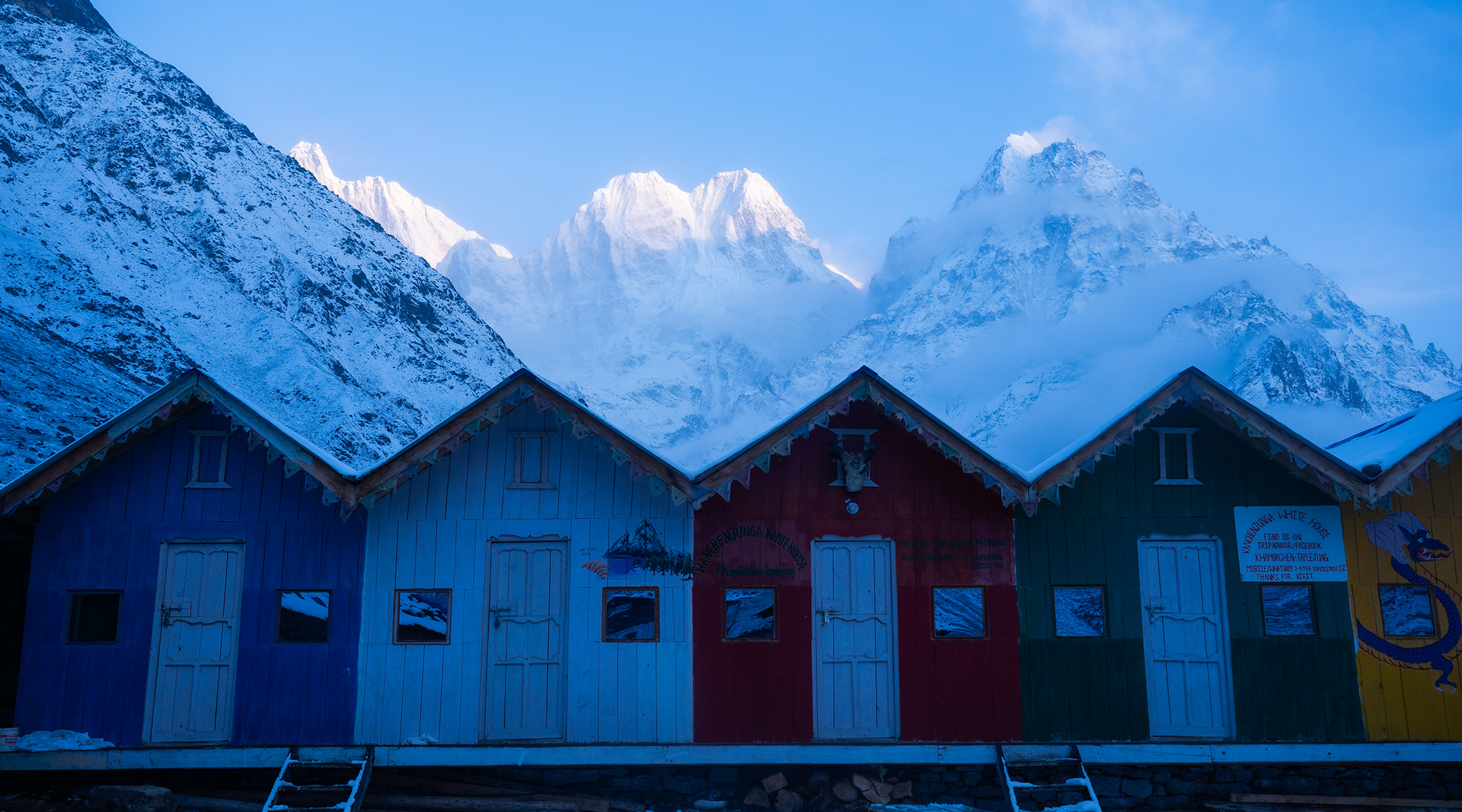
Climbing a bit further uphill, if the weather is clear, you will be rewarded with magnificent views of the majestic Mt.Jannu Himal (Kumbhakarna) rising proudly before you. Moving ahead, you
will cross a suspension bridge and finally arrive at the beautiful village of Khambachen.
Trek through scenic rhododendron forests along the Ghunsa River, gradually ascending into alpine terrain with breathtaking views of Mount Jannu. Crossing suspension bridges and remote trails, you will reach the beautiful highland village of Khambachen, surrounded by stunning mountain landscapes.
Day 8: Khambachen to Lhonak
-
Accomodation: Teahouse
-
Meals: Full Board (FB)
-
Elevation: ~4,792 m
-
Duration: 4–5 hours
-
Distance: ~ 9 km
Continue your trek from Khambachen to Lhonak, following the rugged moraine of the Kanchenjunga Glacier through vast alpine valleys with stunning Himalayan views. This scenic trail also offers chances to spot wildlife like the Blue Sheep, making it a truly rewarding high-altitude trekking experience.
Day 9: Lhonak to Pangpema exploration (Kanchenjunga North Base Camp) return to Lhonak
-
Accomodation: Teahouse
-
Meals: Full Board (FB)
-
Elevation: ~5,140 m
-
Duration: 5–6 hours
-
Distance: ~ 16 km
Reach the iconic Pangpema (Kanchenjunga North Base Camp) at 5,143 meters, the ultimate highlight of the journey, offering breathtaking views of Mount Kanchenjunga along with surrounding peaks like Chang Himal and Tent Peak. After soaking in the spectacular Himalayan panorama, return to an overnight stay in Lhonak for a well-earned rest.
Day 10: Lhonak to Khambachen
-
Accomodation: Teahosue
-
Meals: Full Board (FB)
-
Elevation: ~4145 m
-
Duration: 3–4 hours
-
Distance: ~ 9 km
Begin your descent from Lhonak, retracing the scenic trail through rugged landscapes, waterfalls, and alpine valleys while carefully crossing rocky stone-fall sections. After a steady downhill trek of nearly 700 meters, you will arrive back at Khambachen for a peaceful overnight stay surrounded by the serene Himalayas.
Day 11: Kambachen to Ghunsa
-
Accomodation: Teahouse
-
Meals: Full Board
-
Elevation: ~3,415 m
-
Duration: 5–6 hours
-
Distance: ~ 8 km
Descend from Khambachen to Ghunsa with stunning views of Mount Jannu, completing a scenic 700-meter descent through beautiful Himalayan valleys.
Day 12: Ghunsa to Sele La
-
Accomodation: Teahouse
-
Meals: Full Board (FB)
-
Elevation: ~4,480 m
-
Duration: 4–5 hours
-
Distance: ~ 9 km
Enjoy a scenic uphill trek through dense forests toward Selela, taking around five hours with beautiful Himalayan views along the way. Limited accommodation is available at the pass, so advance booking is required.
Day 13: Sele La toTseram via Sinion La, Mirgin La & Sinelapche La
-
Accomodation: Teahouse
-
Meals: Full Board (FB)
-
Elevation: ~4645 m
-
Duration: 6-9 hours
-
Distance: ~ 14 km
Experience the most adventurous day of your journey with an early morning ascent through rocky Himalayan trails toward Sinion La, followed by crossing Mirgin La Pass and Sinelapcha La Pass. Enjoy panoramic Himalayan views along the way before descending to Cheram for an overnight stay.
Day 14: Tseram to Ramche Hike to Oktang(4740 m)
-
Accomodation: Teahouse
-
Meals: Full Board (FB)
-
Elevation: ~4,610 m
-
Duration: 3–4 hours
-
Distance: ~ 13 km
Trek from Tseram to Ramche in about 4 hours, enjoying close views of the Yalung Glacier and surrounding snow-capped peaks. This scenic route leads into a spiritually significant Himalayan region with optional hikes toward Yalung Base Camp and Oktang viewpoint.
Day 15: Ramche to Torongding
-
Accomodation: Teahouse
-
Meals: Full Board (FB)
-
Elevation: ~2980 m
-
Duration: 5–6 hours
-
Distance: ~ 18 km
Descend through the Kanchenjunga Conservation Area from alpine terrain into forests rich with wildlife like the Red Panda, and reach the remote village of Torongding with basic teahouse facilities.
Day 16: Torongding to Yarsang
-
Accomodation: Teahouse
-
Meals: Full Board (FB)
-
Elevation: ~2100 m
-
Duration: 3–4 hours
-
Distance: ~ 9-11 km
Trek through dense rhododendron, pine, and bamboo forests with no settlements along the route until reaching the remote stop at Yarsang near the final hour of the journey.
Day 17: Yarsang to Zerokilo Drive to Taplejung
-
Accomodation: Teahouse
-
Meals: Full Board (FB)
-
Elevation: ~2,080 m
-
Duration: 6–7 hours
-
Distance: ~ 5-6 km
Complete your Kanchenjunga trek with a 3-hour walk to Zero Kilo followed by a 3-hour jeep drive to Taplejung Bazaar, where you enjoy a farewell dinner celebrating your Himalayan journey.
Day 18: Drive Taplejung Bazaar to Fikal
-
Accomodation: Teahouse
-
Meals: Full Board
-
Elevation: ~1,460 m
-
Duration: 6-7 Hours
-
Distance: ~ 190 km
After breakfast, retrace your route through scenic hills and tea estates to Phikkal, with an optional visit to the tea gardens. Continue driving through rural towns and riverside landscapes to Ilam, showcasing a beautiful contrast between mountain wilderness and cultivated countryside.

Day 19: Drive to Bhadrapur and fly back to Kathmandu
-
Accomodation: Hotel
-
Meals: Breakfast | Soft drinks
-
Elevation: ~1,340 m
-
Duration: 3 - 4 hr drive + 45 min flight
-
Distance: To Bhadrapur airport 54 km
Travel about 2 hours to Bhadrapur for your flight to Kathmandu, experiencing a noticeable transition from cool hills to warmer lowland landscapes.
Kanchenjunga Circuit Trek Package Cost, Inclusions & Exclusions – 2026 Guide
If you are not fully satisfied with the itinerary, inclusions, or exclusions, or if you prefer a more personalized experience, we also specialize in fully customized private treks. Contact us to design your ideal Himalayan journey tailored to your needs, pace, and preferences for a truly memorable adventure.
-
 International airport pickup and drop-off services.
-
Kathmandu to Bhadarapur and back by flight; all airport taxes are included.
-
An English-speaking professional trekking guide (including his salary, food, accommodation, and insurance).
-
Guide flight ticket and necessary ground transportation.
-
Kanchenjunga Restricted Area Permit (KRAP).
-
Kanchenjunga Conservation Area Permit (KCAP).
-
All necessary ground transportation by local jeep (Bhadrapur to Taplejung to Sekhathum and same way back to Jhapa)
-
The hotel to the bus station is transported by car or taxi.
-
Three meals a day during the trek (breakfast, lunch and dinner).
-
Accommodation during the trek will be in tea houses or lodges on a twin-sharing basis.
-
Kanchenjunga Circuit Trekking maps.
-
All government tax and service fees.
-
 International flights
-
Nepal Visa Fees (15 Days-$30, 30 Days- $50, and 90 Days- $125).
-
Travel Insurance & Personal gear
-
Food and accommodation in Kathmandu.
-
Any kind of drink during the trek.
-
Personal expenses (phone calls, bar bills, battery charge, boiled water, laundry, hot shower, snacks, and Wi-Fi in the mountain).
-
Private jeep if needed.
-
Tips for guide and porters.
-
Any additional services not listed in the included section.
This cost and inclusion are based on standard group bookings. If you are not satisfied with the itinerary or package includes details, please contact us, we are happy to customize the trek according to your preferences.
Kanchenjunga Circuit Trek: Route & Map
The Kanchenjunga Circuit Trek takes you deep into the far eastern corner of Nepal’s Himalayas. The journey starts in the lowlands at Bhadrapur (Jhapa), traveling through the beautiful tea gardens of Ilam and the rolling hills of Taplejung before entering the rugged Kanchenjunga Conservation Area.
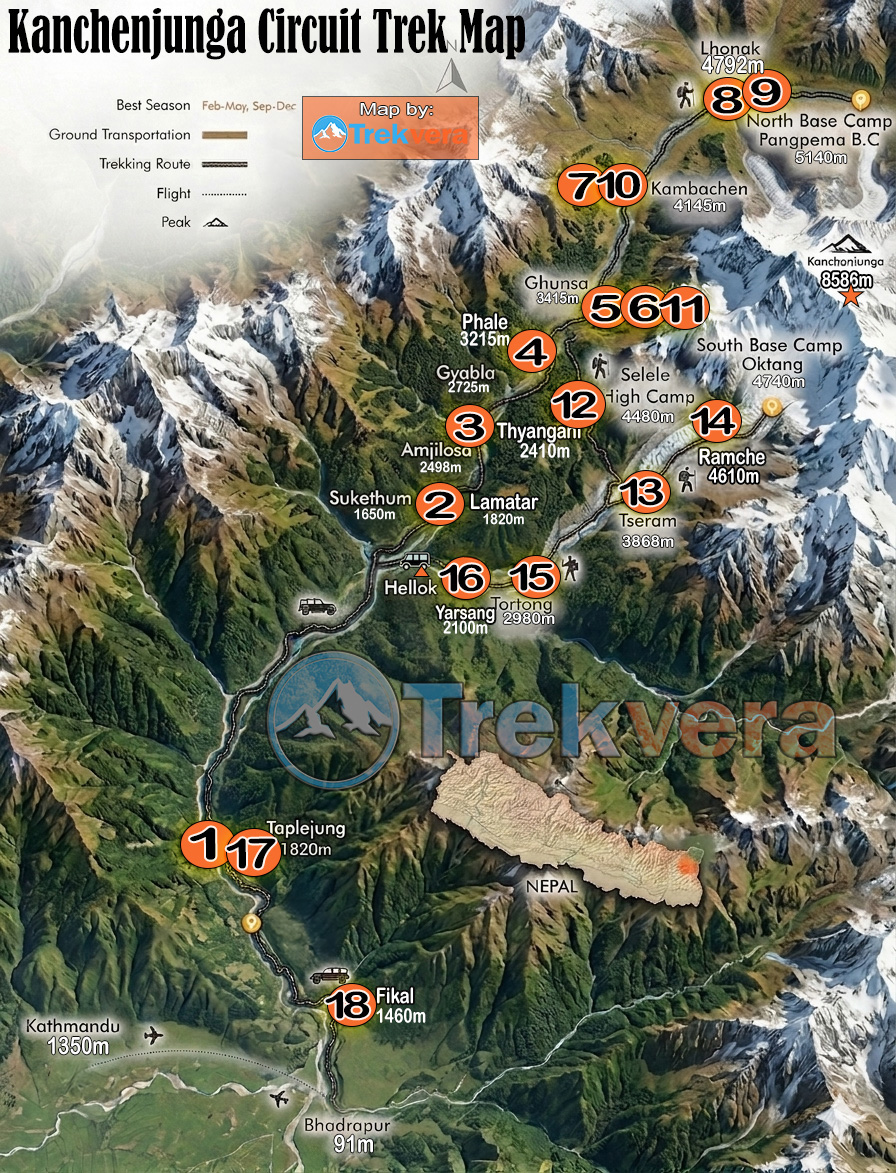
Once you leave the main market of Phungling in Taplejung, the real adventure begins. A three-hour drive on a rough dirt road along the Tamur River brings you to Sekathum. From there, you begin trekking through remote mountain villages like Lamatara, Amjilosa, Thangay, Gyabla, and Phale before reaching the high-altitude settlement of Ghunsa.
This trek is special because it allows you to reach both the North and South Base Camps, offering a close-up view of Mt.Kanchenjunga (8,586 m), the third “highest peak in the world” which spreads out before you like a vast “ocean of snow.”
From Ghunsa, the trail climbs through Khambachen and the high Lhonak Valley to reach the northern high point at Pangpema (North Base Camp). Afterward, the route gets more challenging as you cross high mountain passes like Sinion La, Mirgin La, and Sinelapcha. Passing through Cheram and Ramche, the trail eventually connects with the Yalung Glacier and the South Base Camp, completing a truly massive and unforgettable loop.
Is the Kanchenjunga Circuit Trek Suitable for Beginners?
The Kanchenjunga Circuit Trek is definitely achievable for beginners, but it is not a walk in the park. While you don’t need previous mountaineering skills, you do need to be physically fit and have the mental grit to handle high altitudes and long days. With the right preparation and a professional guide by your side, first-time trekkers can absolutely find success on this route.
To enjoy the journey, you should be comfortable walking 6 to 8 hours a day on rugged, uneven trails. You’ll need the stamina to carry your own daypack while climbing steady inclines above 3,500 meters, and the strength to cross challenging high passes like Sinion La, Sele La, and Sinelapcha.
How to Prepare:
If you are planning to take on this challenge, start getting ready 6 to 8 weeks before your flight to Nepal:
- Boost your cardio: Focus on activities like running, cycling, or swimming to improve your heart and lung capacity.
- Build leg strength: Squats and lunges will help your muscles handle the steep climbs and descents.
- Practice with weight: Go for local hikes wearing a loaded backpack to get your shoulders and back used to the weight you’ll carry on the trail.
Key Things to Keep in Mind:
This trek demands more than just physical strength; it requires altitude discipline (walking slowly and staying hydrated) and mental resilience. Because the terrain is so remote, solo trekking is now allowed but honestly not safe. Heading out with an experienced guide significantly increases your safety and ensures you actually reach those incredible base camps.
Villages and Local Life on the Kanchenjunga Circuit
The early stages of the Kanchenjunga Circuit Trek will take you through some truly amazing villages. As you walk, you’ll feel deeply immersed in Nepal’s rich cultural heritage. In the lower valleys, you’ll encounter the Limbu and Rai communities; their unique traditions, customs, and house styles perfectly reflect the local culture. As you climb higher, the influence shifts toward Tibetan Buddhism, with houses built in a distinct Himalayan style. Life here still revolves around farming, yak herding, and seasonal trade, keeping the mountain lifestyle incredibly authentic and raw.
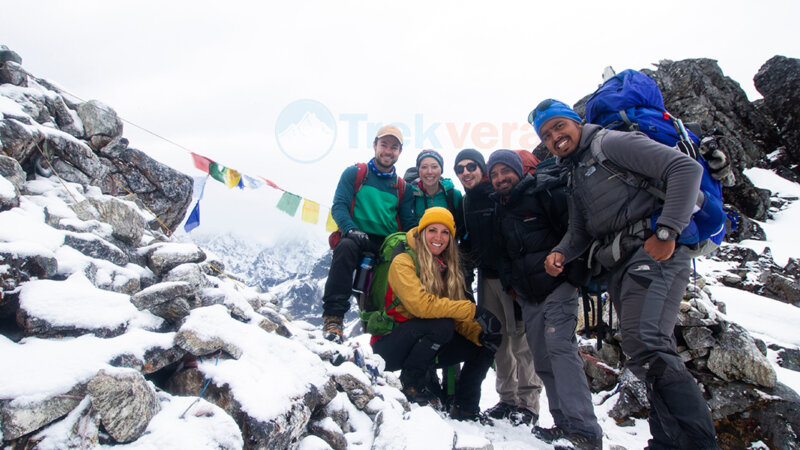
In the lower regions, you’ll mostly see houses with four-sided thatched roofs. However, once you pass Gyabla, the lifestyle changes completely. You’ll see sturdy stone houses, colorful prayer flags (Lungta) fluttering in the wind, ancient monasteries, mani walls carved with mantras, and white chortens. These aren’t just for show; they are a central part of daily life, showing the deep spiritual roots and traditions of the people living here.
Food and Accommodation
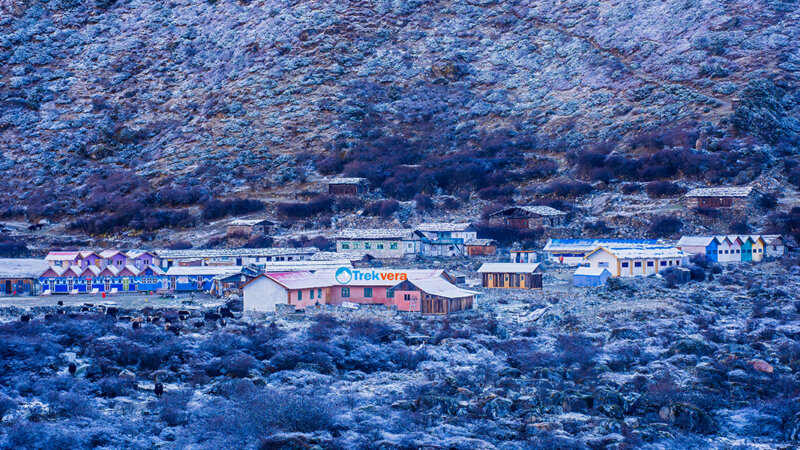
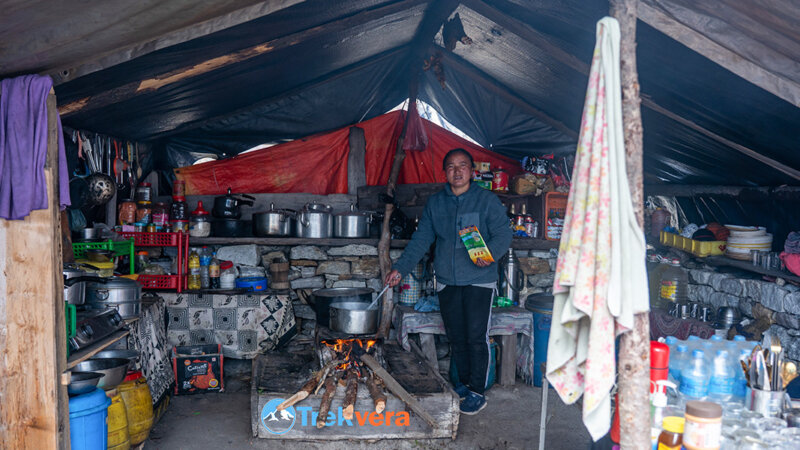
For staying overnight, the Kanchenjunga route uses a “Teahouse” model. However, you should keep in mind that the facilities are much more basic compared to popular areas like Annapurna or Everest. These lodges are run by local families and usually offer simple rooms with two twin beds and shared toilets. In the higher camps, the teahouses provide only the most essential comforts.
The food is organic and packed with nutrition, though your options will be a bit limited. Most menus feature staples like Dal Bhat (lentil soup and rice), Thukpa, Thentuk, various soups, potatoes, and seasonal vegetables.
Hygiene is generally good, it’s always wise to follow your guide’s advice and use water purification tablets or filters to stay healthy at high altitudes.
Nature, Wildlife, and the Conservation Area
Since this trek is located within the Kanchenjunga Conservation Area (Nepal’s largest protected zone) you’ll be surrounded by an incredible variety of plants and animals. The landscape stretches all the way from lush tropical valleys to high-altitude glacial zones.
In the lower sections, you’ll walk past large cardamom farms, thick rhododendron forests, and bamboo groves. As you gain elevation, the scenery shifts to juniper bushes, high Himalayan meadows, and massive glaciers near the base camps.
This region is a sanctuary for rare wildlife like the Snow Leopard, Red Panda, Blue Sheep (Naur) and Himalayan Thar. While seeing them is a rare stroke of luck, knowing they are nearby adds to the magic of the trek. To protect this fragile ecosystem, it’s vital to practice responsible trekking: minimize your waste, respect the animals’ habitats, and support the local economy by staying in community-run lodges.
Kanchenjunga Circuit Trek FAQs
Find answers to the most common questions about the Kanchenjunga Circuit Trek, including permits, itinerary, cost, and difficulty.
How long is the Kanchenjunga Circuit Trek, and how far do you walk?
19 days total (17 trekking days) per your standard package; your detailed guide section cites a 19–22 day range and 215–240 km total walking distance.
What’s the difference between the Circuit Trek and just doing the North or South Base Camp?
The Circuit is the only itinerary on your site that reaches both Pangpema (North Base Camp) and Oktang/Ramche (South side), connected by three high passes: Sinion La (4,646 m), Mirgin La (4,645 m), and Sele La (4,480 m).
What high passes does the Circuit cross?
Sinion La, Mirgin La, Sinelapcha La, and Sele La — your itinerary calls the Sele La-to-Tseram day (crossing three passes in one push) “the most adventurous day of your entire journey,” starting around 4 a.m.
Is the Kanchenjunga Circuit Trek suitable for beginners?
Your page states it’s achievable for beginners without prior mountaineering skills, provided they’re physically fit, comfortable walking 6–8 hours a day, and prepare for 6–8 weeks beforehand. Note: this claim sits differently from your other two pages — see the inconsistency flag below.
Do I overnight at Pangpema on the Circuit, or is it a day trip from Lhonak?
On the Circuit itinerary, Pangpema is a day exploration from Lhonak with return to Lhonak the same night — you do not overnight at Base Camp itself, unlike the standalone North Base Camp Trek.
How much does the Kanchenjunga Circuit Trek cost, and what’s included?
The Kanchenjunga Circuit Trek typically costs between $1,500 to $3,000 per person, depending on the trekking agency, duration, and inclusions. Costs generally cover permits, accommodation, meals, a guide, and porters. Additional expenses may include flights to the starting point and personal gear.
What extra costs should I budget on the trail (Wi-Fi, showers, tips)?
hot showers $2–5, device charging $2–5, Wi-Fi $5–10/session, recommended guide tip ~$250 (shared across the group) and porter tip ~$150 (per trekker who hired one).
Can I trek the Circuit solo?
Yes. As of March 2026, solo trekkers can obtain the Kanchenjunga Restricted Area Permit and complete the full Kanchenjunga Circuit Trek without needing a second trekker — provided you travel with a licensed guide from a registered trekking agency, which remains mandatory.
Before this rule change, Nepal required a minimum of two foreign trekkers to be listed on any Restricted Area Permit (RAP), which affected all 15 of Nepal’s restricted trekking zones, including Kanchenjunga. Solo travelers previously had to either find a trekking partner or pay to cover a “phantom” second permit.
On 22 March 2026, Nepal’s Department of Immigration removed this two-person minimum, acting on a formal proposal submitted by the Trekking Agencies’ Association of Nepal (TAAN). The change applies across all restricted areas, including Taplejung district, where the Kanchenjunga Circuit, North Base Camp, and South Base Camp treks are located.
What did not change:
A licensed guide from a government-registered trekking agency is still legally required — this was never tied to the two-person rule and remains mandatory for every trekker, solo or in a group.
You still cannot obtain a Restricted Area Permit independently; it must be processed through a registered agency.
You must still stay on your approved route and carry your permit at all times for checkpoint inspection.
What’s the best season for the Circuit, and can I trek in winter?
Spring (March–May) and Autumn (Sept–Nov) recommended. Your page confirms winter trekking is technically possible but not advised without an experienced guide, since many teahouses close and trails can be snow-blocked.
Why with us
Choose us for expert-guided, safe, and hassle-free trekking experiences with 24/7 support, personalized trip briefing, and easy booking worldwide.
-
Local Expert Guides
Local, licensed expert guides with strong route knowledge and highly recommended by many travelers for safe and authentic trekking experiences.
-
24/7 Support Team
Our support team is available 24 hours a day, 7 days a week via email to assist you.
-
Free Private Airport Pickup & Drop
Enjoy a seamless travel experience with complimentary private airport transfer services.
-
Free Cancellation & Reschedule
Our tour package includes free cancellation or reschedule if plans change.
